
Conflict Resolution in Relationships: Rebuilding Trust, Financial Honesty and Better Communication
How to navigate relationship conflict, communicate honestly and rebuild trust in midlife relationships.
Conflict is a natural part of relationships. Two people bring different backgrounds, values, experiences and expectations into a partnership. Even when there is love and commitment, disagreements can arise around finances, trust, communication and what each person wants for the future.
But when the same arguments keep happening, conversations become defensive, or important issues are avoided altogether, conflict can gradually erode the connection between two people.
The good news is that conflict does not automatically mean a relationship is failing. How we respond to conflict, take responsibility for our behaviour and communicate our needs can make a significant difference.
For people navigating relationship uncertainty or building a new partnership in midlife, learning healthier ways to resolve conflict can be an important step towards creating a relationship grounded in honesty, trust and mutual respect.
Why Do Couples Keep Having the Same Arguments?
Recurring arguments are often about more than the issue being discussed.
A disagreement about spending, for example, might reflect deeper concerns about security, control, fairness or feeling unheard. An argument about a forgotten promise might bring up past experiences of disappointment or betrayal.
When emotions run high, it can become difficult to listen to understand. Instead, we may focus on defending ourselves, proving our point or protecting ourselves from feeling hurt.
Over time, this can create a familiar pattern: one person pushes for answers while the other withdraws, one becomes critical while the other becomes defensive, or both avoid difficult conversations until frustration builds.
Recognising these patterns is an important first step towards healthier conflict resolution.
Rather than asking, "Who is right?", try asking, "What is happening between us, and what do we each need to understand?"
1. Financial Conflict: Creating Openness and Shared Understanding
Money is one of the most sensitive topics in relationships. It can represent security, independence, freedom, responsibility and even self-worth.
Partners may have very different financial histories. One person may have grown up in a household where money was scarce, leading them to save carefully. Another may associate spending with enjoyment, generosity or living in the moment.
In midlife, financial conversations can become even more complex. There may be mortgages, retirement planning, previous relationship commitments, children, different incomes, debts or assets to consider.
Problems often arise when assumptions replace honest discussion.
One partner might believe finances should be shared, while the other values financial independence. One may feel anxious about spending, while the other feels restricted by close monitoring. Without open communication, these differences can become a source of resentment.
How to approach financial disagreements more constructively:
- Be transparent. Discuss income, debts, financial commitments and spending expectations honestly, especially when making decisions that affect you both.
- Explore your money beliefs. Consider what you learned about money growing up and how those experiences influence your decisions today.
- Avoid blame and shame. Focus on understanding the situation and agreeing on practical next steps rather than criticising past decisions.
- Agree on shared expectations. Talk about joint expenses, individual spending, savings, financial responsibilities and future goals.
- Respect financial autonomy. A healthy partnership allows for both shared responsibility and appropriate individual independence.
Financial honesty is not about controlling one another. It is about creating enough transparency to make informed decisions and establish realistic expectations together.
2. Rebuilding Trust: Actions Matter More Than Promises
Trust is fundamental to emotional security. When it has been damaged by dishonesty, broken promises, secrecy or infidelity, the relationship may no longer feel like a safe place to be vulnerable.
The person who has been hurt may question what is true, seek reassurance or become more alert to potential signs of further disappointment. The person who has caused the hurt may feel ashamed, defensive or frustrated that the past continues to affect the present.
Both people can become caught in a cycle that makes repair difficult.
Rebuilding trust requires more than saying, "It won't happen again." It involves taking responsibility, acknowledging the impact of what happened and demonstrating change consistently over time.
Practical steps towards rebuilding trust include:
- Acknowledge the hurt. Listen to the impact of your actions without immediately defending your intentions.
- Take responsibility. Be willing to recognise your part in what happened and make meaningful changes.
- Communicate honestly. Answer reasonable questions openly and avoid further secrecy or half-truths.
- Follow through on commitments. Consistency between words and actions helps restore confidence.
- Allow time for repair. Trust cannot be rushed, and the person who has been hurt may need time to process what happened.
- Establish clear boundaries. Discuss what both partners need to feel respected and emotionally safe moving forward.
Rebuilding trust is a shared process, but it does not mean both people are equally responsible for the original breach. The person who broke trust must take responsibility for their actions, while the person who was hurt retains the right to decide what they need and whether continuing the relationship is right for them.
Forgiveness cannot be demanded, and trust cannot be rebuilt through pressure or promises alone.
3. Honest Communication: Speaking Without Blaming
Honest communication is not simply saying whatever comes to mind. It means expressing your feelings, needs and concerns clearly while remaining respectful of the other person.
When we feel hurt or misunderstood, it can be tempting to use statements such as:
"You never listen to me."
"You always make everything about yourself."
"You can't be trusted."
Although these words may reflect genuine frustration, they can leave the other person feeling attacked and less willing to listen.
A more constructive approach is to describe your experience without making assumptions about the other person's intentions.
For example:
Instead of: "You never tell me what's going on with the money."
Try: "I feel anxious when I don't understand our financial position. I'd like us to sit down together and discuss our commitments so we both know where we stand."
Instead of: "You obviously don't care about rebuilding trust."
Try: "I'm finding it difficult to feel secure after what happened. I need us to talk about what consistency and openness will look like from here."
Instead of: "You never listen to me."
Try: "I don't feel heard when our conversations turn into arguments. Could we take turns explaining our perspectives before responding?"
These changes do not guarantee agreement, but they create a better opportunity for understanding.
Honesty and kindness can coexist. You can express disappointment, set boundaries and address difficult truths without humiliating, threatening or attacking your partner.
4. Learn to Pause Before Reacting
During conflict, strong emotions can make it harder to think clearly, listen carefully and respond thoughtfully.
You might notice your heart racing, your body tensing, your thoughts speeding up or an overwhelming urge to defend yourself. Alternatively, you might shut down, withdraw or struggle to find words.
These reactions can make productive conversations difficult.
Learning to recognise your own emotional responses can help you interrupt familiar patterns before they escalate.
When a conversation becomes overwhelming, consider taking a pause. Explain that you want to continue the discussion, but need some time to settle first. Agree on when you will return to the conversation rather than leaving the issue unresolved.
During the pause, take a few slow breaths, go for a short walk or give yourself time to reflect on what you are feeling.
When you return, ask yourself:
- What am I feeling beneath my anger or frustration?
- What am I afraid might happen?
- What do I need my partner to understand?
- What can I take responsibility for in this situation?
- Am I ready to listen as well as speak?
Emotional regulation is not about suppressing feelings. It is about creating enough space to choose how you respond.
5. Moving From Winning the Argument to Understanding Each Other
In a healthy relationship, resolving conflict is not about one person winning and the other losing.
It is about understanding different perspectives, identifying what matters most to each person and finding a way forward that respects both individuals.
This may involve compromise, clearer boundaries, a change in behaviour or accepting that some differences require ongoing discussion.
Try setting aside time for a calm conversation when neither person is already upset. Choose one issue to focus on, allow each person to speak without interruption, and summarise what you have heard before offering your own perspective.
You do not have to agree with everything your partner says to acknowledge that their experience is real to them.
At the same time, healthy conflict resolution does not mean tolerating intimidation, coercion, financial control or repeated dishonesty. Respect, accountability and emotional and physical safety must remain central.
If conversations repeatedly become hostile or feel unsafe, professional support may be appropriate. Where there is abuse or coercive control, seek individual specialist support rather than assuming joint conversations or couples work are safe.
What If You Are Unsure About the Future of Your Relationship?
Sometimes conflict raises a bigger question: can this relationship become what I need it to be?
You may care deeply about your partner while feeling uncertain about whether your differences can be resolved. You may be trying to rebuild trust while questioning whether enough has changed. Or you may be entering a new relationship and wanting to avoid repeating patterns from the past.
You do not need to have every answer immediately.
Taking time to understand your relationship patterns, clarify your values and identify your boundaries can help you make more considered decisions about your future.
The goal is not to preserve a relationship at any cost. It is to understand what is happening, recognise what needs to change and decide what is right for you.
Taking the Next Step Towards Healthier Relationships
Conflict can reveal important information about a relationship: where communication breaks down, which needs remain unmet and what each person is willing to take responsibility for.
With greater self-awareness, honest communication and consistent action, it is possible to approach difficult conversations differently.
Whether you are navigating relationship uncertainty, working through trust issues or hoping to build a healthier partnership in midlife, you can begin by focusing on what is within your control: your responses, your boundaries, your communication and the choices you make moving forward.
At Take The Next Step, I offer relationship coaching to help people gain clarity, understand recurring patterns and navigate relationship challenges with greater confidence and self-awareness.
You do not have to work everything out alone.
Ready to explore your next step?
Visit "Take The Next Step" (https://www.takethenextstep.nz) to learn more about relationship coaching and arrange a complimentary Next Step Call.
Your next chapter begins with understanding yourself, communicating honestly and choosing your way forward.
Your NEXT STEP CALL is here.
Relational Anxiety in Midlife Dating: When Opening Up Feels Hard
Opening yourself up to someone new can feel very different in midlife.
You may genuinely want companionship, connection and the possibility of a loving relationship again — yet find yourself holding back when someone begins to get closer.
You might wonder:
Can I trust this person?
What if I get hurt again?
What if I lose myself in another relationship?
Why am I suddenly anxious when everything seems to be going well?
Should I move towards this person — or step away?
This can be relational anxiety.
It doesn't necessarily mean that something is wrong with you, or that the person you're dating is wrong for you. Sometimes, your emotional system is simply trying to protect you based on what you've experienced before.
What is relational anxiety?
Relational anxiety is the worry, fear or uneasiness that can arise around emotional closeness, trust, vulnerability or uncertainty in relationships.
In midlife, it can be particularly complicated because you're not entering relationships with a blank slate.
You may have experienced a marriage, long-term partnership, separation, betrayal, rejection, loss or repeated relationship patterns. You may also have spent years developing independence and learning how to rely on yourself.
So when someone new comes along, there can be two very real parts of you operating at the same time:
One part wants connection.
Another part wants protection.
That internal tension can make dating feel confusing.
When the past meets someone new
Past relationship experiences can influence how we interpret what is happening in the present.
If you've been betrayed, dismissed, abandoned or emotionally hurt, your mind may become particularly alert to signs that something similar could happen again.
A delayed message may feel significant.
A change in someone's tone may make you question their feelings.
A moment of emotional distance may trigger thoughts about rejection.
Or perhaps the opposite happens.
You become uncomfortable when someone shows genuine interest and start finding reasons to create distance.
None of this means your reactions are irrational.
Your experiences have taught you things.
But sometimes the protective strategies that helped you survive a difficult relationship can become less helpful when you're trying to build a new one.
Protective mechanisms can look like many things
Protection doesn't always look like obvious avoidance.
It can show up as:
overthinking someone's behaviour
constantly analysing whether they are right for you
looking for red flags
keeping emotional distance
needing reassurance
becoming hyper-independent
finding reasons to leave when intimacy increases
becoming anxious when someone doesn't respond quickly
trying to control the pace of the relationship
comparing a new person with someone from your past
telling yourself you don't really need anyone
staying emotionally guarded even when you want closeness
These responses can be understandable attempts to create safety.
The question isn't necessarily, "How do I stop feeling anxious?"
A more useful question may be:
"What is my anxiety trying to protect me from?"
Your nervous system can become part of the story
Relationships aren't only about what we think.
They can also affect our nervous system.
When you feel emotionally safe, your body may be able to relax, stay present and remain open to connection.
When something feels threatening — whether the threat is real, uncertain or connected to a previous experience — your nervous system may move into a protective state.
You might experience:
racing thoughts
a tight chest
a knot in your stomach
difficulty sleeping
feeling restless or on edge
an urge to withdraw
a strong need for reassurance
feeling overwhelmed by closeness
Sometimes your body reacts before you've consciously worked out what is happening.
This is why simply telling yourself to "stop overthinking" doesn't always work.
Your nervous system may need a sense of safety before your thinking mind can regain perspective.
Emotional regulation matters when you're dating
Emotional regulation doesn't mean never becoming anxious.
It means developing the ability to notice what is happening inside you without immediately allowing the feeling to make the decision for you.
For example:
Feeling:
"I'm anxious because they haven't replied."
Instead of immediately concluding:
"They've lost interest."
You might pause and ask:
"What do I actually know?"
Then:
"What am I assuming?"
And finally:
"What is this situation bringing up for me?"
That small pause can create space between the emotional reaction and the action you take.
And that space can be incredibly valuable.
You don't have to choose between vulnerability and self-protection
Opening yourself to someone new doesn't mean abandoning your boundaries.
You can be open and discerning.
You can be vulnerable and still move slowly.
You can care about someone and continue to pay attention to how they treat you.
You can allow someone closer without handing them responsibility for your emotional wellbeing.
Healthy connection isn't about removing all protection.
It's about developing protection that is proportionate to what is actually happening in the present.
Are you responding to the person in front of you — or the person from your past?
This can be one of the most useful questions to explore when dating after hurt.
Ask yourself:
What is happening right now?
And:
What does this remind me of?
Those are two different questions.
Perhaps the person you're dating really is showing behaviour that concerns you.
Or perhaps something relatively small has activated an old wound.
Learning to distinguish between the two can help you make decisions from a more grounded place.
You can learn to feel safer in connection
If you're dating again in midlife, you don't need to become a completely different person.
You don't need to eliminate your fears before you're "ready" for another relationship.
Instead, you can begin to understand your patterns.
You can learn what activates you.
You can recognise your protective mechanisms.
You can develop emotional regulation skills.
You can become more aware of what your nervous system is communicating.
And you can gradually learn how to stay connected to yourself while allowing someone else to come closer.
That is often the real work of opening yourself to love again.
Not becoming fearless.
Becoming more grounded.
A few questions to reflect on
If you're experiencing relational anxiety while dating, consider:
What am I afraid might happen if I let this person get closer?
Is this fear connected to something I've experienced before?
What is actually happening in the present — separate from my assumptions?
What does my body do when I feel emotionally unsafe?
What protective behaviour do I tend to use when I feel vulnerable?
Can I pause before acting on my anxiety?
What would it look like to stay open while still maintaining healthy boundaries?
You don't have to have all the answers immediately.
Sometimes the next step is simply becoming curious about what is happening inside you.
Opening up again doesn't mean forgetting what happened before.
It means learning from the past without allowing it to automatically determine your future.
And perhaps that's one of the most important parts of dating in midlife:
Learning how to protect yourself without closing yourself off from connection.
If you're questioning whether you're ready for a new relationship, feeling anxious about opening up, or trying to understand your patterns in relationships, taking some time to pause, understand and clarify what is happening can help you move forward with greater confidence and self-trust.
Take The Next Step offers grounded support for people navigating relationship uncertainty, dating, re-partnering and the emotional complexity of creating a new chapter in midlife.

Where Are Your Relationship Blind Spots? When You're Asking, “Should I Stay or Should I Go?”
There can be a point in a relationship when you find yourself asking questions you never expected to ask:
Should I stay?
Should I go?
Can this relationship change?
Am I expecting too much—or settling for too little?
Is this a difficult season, or is something fundamentally no longer working?
Relationship uncertainty can be exhausting because the answer rarely feels completely clear.
And when you're emotionally invested in a relationship, it can be difficult to see the situation objectively.
This is where your relationship blind spots may matter.
What is a relationship blind spot?
A blind spot is something influencing the way you see your relationship that you may not be fully aware of.
It doesn't necessarily mean you're making the wrong decision.
It may simply mean that there are factors affecting your perspective that deserve closer attention.
For example, you might be:
overlooking your own needs because you're focused on keeping the peace
staying because you're afraid of what life would look like alone
considering leaving because you're emotionally exhausted, without yet understanding what is underneath that exhaustion
repeatedly hoping your partner will change
minimising patterns that have been hurting you for years
interpreting every disagreement as evidence that the relationship is failing
comparing your relationship with other couples
holding onto the relationship you hoped it would become rather than the relationship you're actually experiencing
allowing past relationship experiences to influence how you interpret what is happening now.
None of these automatically tells you whether you should stay or leave.
They are simply worth exploring.
Sometimes the question isn't “Should I stay or go?”
When you're caught in relationship uncertainty, it can be tempting to look for a definitive answer.
Stay.
Leave.
But sometimes a more useful place to begin is:
“What am I not seeing clearly yet?”
That question creates space for curiosity rather than urgency.
You can begin to separate the different layers of what you're experiencing.
What is happening in the relationship?
Look at the observable reality.
How do you communicate?
How are disagreements handled?
Do you feel respected?
Is there emotional connection?
Are your needs heard?
Are there recurring patterns that never seem to change?
And importantly, what happens after conflict?
Does there tend to be repair, understanding and movement forward—or does the same cycle simply repeat?
What is happening within you?
Your own emotional experience matters too.
Are you feeling disconnected, resentful, anxious, lonely or unheard?
Are you becoming someone you don't recognise?
Or are you feeling frightened by the possibility of losing something that still matters deeply to you?
Sometimes relationship uncertainty is partly about the relationship—and partly about what the relationship is bringing up within you.
Are you staying because you want to—or because you're afraid to leave?
Fear can be a powerful influence on relationship decisions.
You might fear:
being alone
starting again
financial uncertainty
disappointing your family
hurting your partner
dating again
what other people will think
making the wrong decision
regretting leaving.
Those fears are real.
But fear and desire aren't necessarily the same thing.
One useful question is:
“If I knew I would be okay either way, what would I honestly want?”
You don't have to act on the answer immediately.
Sometimes simply allowing yourself to hear your own answer can be revealing.
Are you expecting change—or seeing evidence of it?
Hope can keep a relationship alive.
But there is an important distinction between hoping something will change and seeing meaningful evidence that it is changing.
Ask yourself:
What has actually changed?
Not what has been promised.
Not what you wish could happen.
Not what might happen one day.
What is different in the relationship now?
And has that change been consistent enough to create a different experience for both of you?
Are you looking at the whole relationship—or only the difficult parts?
When you're unhappy, it's easy for your attention to narrow around everything that isn't working.
But the opposite can also happen.
You may focus so strongly on the good memories, shared history, family, or the reasons you originally fell in love that you minimise what isn't working today.
Try stepping back.
Ask yourself:
“If I looked at my relationship as a whole, what would I see?”
The good.
The difficult.
The growth.
The patterns.
The connection.
The disconnection.
The things that have changed.
And the things that haven't.
You don't have to make everything equal.
You simply want to see the picture more clearly.
Your history can become a blind spot too
Our previous experiences can shape what we expect from relationships.
Perhaps you've experienced abandonment, betrayal, rejection or instability before.
Perhaps you've learned to avoid conflict.
Perhaps you've learned to over-function—to keep everything together.
Perhaps you've become very independent because relying on someone else hasn't always felt safe.
Understanding these patterns isn't about blaming yourself.
It's about becoming more aware of the lens through which you're viewing your current relationship.
Because sometimes we're responding not only to what is happening now, but also to what has happened before.
You don't have to make the decision today
If you're asking, “Should I stay or should I go?”, you may feel enormous pressure to reach an answer.
But clarity doesn't always arrive as one dramatic moment.
Sometimes it develops through a series of smaller questions.
What do I need?
What am I experiencing?
What patterns keep repeating?
What have I been avoiding?
What am I afraid of?
What is within my control?
What would need to change for this relationship to feel healthy and sustainable for me?
Is there evidence that meaningful change is possible?
And perhaps most importantly:
“What am I not seeing because I'm standing too close to it?”
That is where exploring your blind spots can be valuable.
Not because someone else should decide whether you stay or leave.
But because you deserve the opportunity to make an important decision from greater clarity rather than fear, pressure or confusion.
When you need space to think clearly
You don't necessarily need someone to tell you what to do.
Sometimes you need a calm, structured space to slow things down, understand what's happening, explore your own patterns and clarify what matters to you.
That's the purpose of relationship clarity work.
Pause. Understand. Clarify. Move Forward.
The goal isn't to tell you whether you should stay or go.
It's to help you understand your situation more clearly—so that whatever you decide is a decision you can stand behind.
If you're currently questioning your relationship and would like a confidential space to explore what's really going on, you can learn more about The Next Step Clarity Session at Take The Next Step.
It Doesn’t Hurt to Be Stretched a Little: Finding Your Full Potential Through a Midlife Relationship Transition
Sometimes the life we thought we wanted has to stretch before we discover the life that truly fits.
Midlife relationship transitions can be uncomfortable.
Whether you are separating, rebuilding after divorce, questioning a long-term relationship, dating again, or simply wondering what you want your next chapter to look like, there can be moments when life feels unfamiliar.
You may find yourself thinking:
“I don't know who I am anymore.”
“I thought I'd have this figured out by now.”
“What if I make the wrong decision?”
“Am I really capable of starting again?”
These questions can feel unsettling.
But perhaps there is another way to look at this period of your life.
Perhaps you are not falling apart. Perhaps you are being stretched.
And sometimes, being stretched is where we discover how much more is possible.
Growth rarely happens entirely inside our comfort zone
There is nothing wrong with wanting security.
After years of relationships, family responsibilities, careers, routines and established identities, familiarity can feel reassuring.
But comfort and fulfilment are not always the same thing.
Sometimes we become so accustomed to the life we have created that we stop asking whether it still reflects who we are becoming.
A midlife relationship transition can interrupt that pattern.
Suddenly, questions that were easy to avoid become difficult to ignore.
What do I actually want?
What matters to me now?
What have I outgrown?
What am I no longer willing to compromise on?
What kind of relationship would genuinely complement the person I am today?
These aren't necessarily signs that something has gone wrong.
They can be invitations to reassess.
Being stretched is not the same as being broken
There is an important distinction here.
Being stretched does not mean forcing yourself to tolerate something unhealthy, staying in situations that harm you, or pushing yourself beyond what you can emotionally manage.
Healthy stretching is different.
It might mean:
having a difficult but necessary conversation
allowing yourself to be vulnerable again
questioning an old belief about relationships
learning to set a boundary
spending time alone without immediately filling the space
dating again after a significant relationship
discovering who you are outside of your previous relationship
making a decision without having absolute certainty
allowing yourself to imagine a different future
These experiences can feel uncomfortable precisely because they take us beyond what is familiar.
And that discomfort doesn't automatically mean “stop.”
Sometimes it means “pay attention.”
Midlife can be a powerful time for identity rebuilding
Relationship transitions often affect much more than our relationship status.
They can affect our sense of identity.
You may have spent years being someone's partner, spouse, parent, caregiver, provider or supporter.
When a relationship changes, some of those roles change too.
That can leave a surprisingly large question:
Who am I now?
Research into midlife identity has found meaningful links between identity and wellbeing, while research on challenging experiences suggests that periods of difficulty can prompt people to revisit and develop their sense of identity.
This is why rebuilding after a relationship transition isn't simply about “moving on.”
It can be about moving towards.
Towards a clearer understanding of yourself.
Towards greater self-trust.
Towards relationships that better reflect your values.
Towards a life that feels more consciously chosen.
What if the stretching is showing you what you're capable of?
Imagine a rubber band.
When it is never stretched, it stays exactly as it is.
Stretch it carefully, and it has greater reach.
Human beings are obviously much more complex than rubber bands—but the metaphor is useful.
Sometimes circumstances ask more of us than we expected.
You might discover that you can:
Have the conversation you once avoided.
Walk away from something that no longer serves you.
Spend time alone and actually enjoy your own company.
Say no without feeling guilty.
Say yes to something that scares you.
Love again without losing yourself.
Choose differently because you understand yourself differently.
And perhaps most importantly:
Trust yourself again.
You don't have to know the whole path
One of the hardest parts of a midlife relationship transition can be the desire for certainty.
We want to know:
Will I be okay?
Will I meet someone again?
Will I make the right decision?
Will I regret leaving?
Will I ever feel settled?
But life rarely gives us those answers in advance.
Sometimes the next step is simply the next step.
You don't need to know exactly what your life will look like five years from now.
You may only need enough clarity to decide what is right for this stage.
That is where conscious reflection becomes valuable.
Instead of asking:
“What should I do?”
you might begin asking:
“What is this experience showing me about myself?”
That is a very different question.
Stretch towards yourself—not away from yourself
There can be a temptation during relationship transitions to immediately look outward.
Should I date?
Should I find someone else?
Should I start again?
Should I make a dramatic change?
But perhaps the most important relationship to rebuild first is the relationship you have with yourself.
Ask yourself:
What have I learned?
What has this relationship transition taught me about my needs, boundaries, values and patterns?
What have I outgrown?
Which expectations, beliefs or behaviours belonged to an earlier version of me?
What do I want now?
Not what your family expects.
Not what society tells you midlife should look like.
Not what your former partner wanted.
What do you want?
Where could I stretch?
Is there one small area where you could step slightly beyond your familiar pattern?
Perhaps it is vulnerability.
Perhaps it is independence.
Perhaps it is saying no.
Perhaps it is allowing yourself to be seen again.
Perhaps it is simply believing that there could be more for you.
Your next chapter doesn't have to look like your last one
One of the gifts of midlife is perspective.
You have lived enough life to know that circumstances change.
You have experienced relationships.
You have made mistakes.
You have learned.
You have survived difficult seasons.
You have probably discovered strengths you didn't know you possessed.
That experience matters.
Your next relationship doesn't have to repeat your previous one.
Your next chapter doesn't have to be a continuation of the last.
And your future doesn't have to be limited by the version of yourself you have been.
Sometimes a relationship transition creates the space to ask a much bigger question:
“Who am I capable of becoming now?”
That question can be both uncomfortable and incredibly liberating.
A gentle challenge for your next step
If you are currently navigating a midlife relationship transition, consider this:
Instead of asking yourself,
“How do I get back to feeling comfortable?”
try asking:
“What might I discover about myself if I allow myself to be stretched—gently, consciously and at my own pace?”
You don't need to rush.
You don't need to have all the answers.
And you certainly don't need to become somebody else.
Perhaps the goal isn't to reinvent yourself.
Perhaps it is to become more fully yourself.
Sometimes the stretch is where the next version of your life begins.
Take The Next Step
A midlife relationship transition can leave you questioning your identity, your choices and what you want from your next chapter.
You don't have to navigate all of those questions alone.
At Take The Next Step, I provide calm, structured support for people navigating separation, identity rebuilding, relationship discernment and conscious re-partnering in midlife.
The aim isn't to tell you what decision to make.
It's to help you slow things down, understand what is happening, reconnect with yourself and move forward with greater clarity.
Your next chapter doesn't have to be rushed.
It just needs to be consciously chosen.
Take the Next Step.
If this resonates with you, and you would like a confidential chat, I offer a FREE 20 min NEXT STEP CALL

Do You Feel Like You Are Throwing Yourself Off a Cliff When Opening Yourself Up to Someone New in a Midlife Relationship Transition?
Opening yourself up to love again after separation or divorce can feel exciting, vulnerable — and terrifying.
You may have spent years learning how to protect yourself.
You know what heartbreak feels like. You may have experienced betrayal, disappointment, rejection, conflict or the painful ending of a long-term relationship.
So when someone new comes along, part of you may think:
“I really like this person.”
While another part quietly whispers:
“Be careful. Don't get too close. You know what happened last time.”
This internal conflict is common during midlife relationship transitions.
You may genuinely want connection, companionship and intimacy while simultaneously feeling the urge to pull back, overthink, analyse or protect yourself.
It can feel almost like throwing yourself off a cliff and hoping someone will catch you.
But what if opening yourself up doesn't have to mean throwing yourself off the cliff?
What if it can mean learning how to take the next step with awareness, boundaries and emotional steadiness?
Protective mechanisms are not your enemy
After a difficult relationship experience, your mind and nervous system can develop ways of trying to keep you safe.
These protective mechanisms might include:
Keeping people at emotional distance
Overthinking every interaction
Looking for signs that something is wrong
Becoming hyper-independent
Avoiding vulnerability
Comparing a new partner with your previous relationship
Assuming the relationship will eventually end
Pulling away when things start becoming emotionally intimate
Needing constant reassurance
Trying to control the pace of the relationship
Convincing yourself that you don't really need anyone
These behaviours aren't necessarily signs that something is wrong with you.
Often, they developed for a reason.
They may have once helped you cope.
The challenge is recognising when a protective mechanism that helped you survive the past is now preventing you from experiencing something different in the present.
The difference between protection and intuition
This is an important distinction when you're dating after separation or divorce.
Intuition tends to be relatively clear and grounded.
It might sound like:
“Something about this situation doesn't feel right.”
A protective response can feel much more urgent:
“Get out before you get hurt.”
Learning to distinguish between the two can be incredibly valuable.
Not every uncomfortable feeling means you should walk away.
Sometimes discomfort simply means you're entering unfamiliar emotional territory.
If you have spent years protecting yourself, vulnerability can feel unsafe even when the person in front of you is treating you well.
That doesn't mean you should ignore red flags.
It means you can learn to slow down enough to ask:
“Is this person actually giving me reason not to trust them, or is my past telling me that closeness itself is dangerous?”
When your past enters a new relationship
One of the complexities of midlife dating after divorce or separation is that you're not starting from a blank page.
You bring your experiences with you.
You may know exactly what you don't want again.
You may also have stronger boundaries, clearer values and a much better understanding of yourself.
But you can also bring fear.
Fear of repeating the past.
Fear of losing yourself again.
Fear of being rejected.
Fear of becoming emotionally dependent.
Fear that you will invest your time and heart only to be hurt again.
And sometimes that fear can cause you to leave emotionally before anything has actually gone wrong.
You don't have to choose between vulnerability and protection
Opening yourself up to someone new doesn't mean handing them complete access to your heart immediately.
Healthy vulnerability can happen gradually.
You can:
Take your time.
You don't have to decide the future of a relationship after a few dates.
Keep your boundaries.
Being emotionally open doesn't mean abandoning your own needs, values or independence.
Stay connected to yourself.
Continue investing in your friendships, interests, routines and identity outside the relationship.
Pay attention to behaviour.
Trust is built through consistency over time — not simply through chemistry or promises.
Allow the relationship to develop at a pace that feels sustainable.
You don't have to leap.
You can take steps.
What does emotional safety actually look like?
When rebuilding your capacity for intimacy in midlife, emotional safety isn't about guaranteeing that you will never get hurt again.
There are no guarantees in relationships.
Instead, emotional safety can come from knowing:
“If something doesn't feel right, I can speak up.”
“I can maintain my boundaries.”
“I don't have to abandon myself to keep someone else.”
“I can leave if the relationship becomes unhealthy.”
“I can trust myself to make decisions.”
This is a very different foundation from trying to make another person responsible for guaranteeing your emotional safety.
You don't have to leap
Perhaps the biggest shift is changing the question.
Instead of asking:
“Can I trust this person enough to completely open myself up?”
try asking:
“What is the next safe and honest step I can take?”
Maybe that is allowing yourself to enjoy the date without analysing where the relationship is going.
Maybe it is telling someone how you actually feel.
Maybe it is expressing a boundary.
Maybe it is allowing someone to support you.
Maybe it is simply noticing your protective response without automatically acting on it.
You don't have to throw yourself off the cliff.
You can stand at the edge, breathe, look around, and decide what the next step looks like.
Your past can inform you without controlling your future
A midlife relationship transition can be an opportunity to approach relationships differently.
You don't have to forget what happened.
You don't have to ignore the lessons you've learned.
And you certainly don't have to ignore genuine red flags.
But you also don't have to let fear make every decision for you.
Protection is useful when it keeps you safe.
It becomes limiting when it keeps you from living.
Opening yourself up again after separation or divorce isn't about becoming fearless.
It's about developing enough self-awareness and emotional steadiness to recognise when fear is speaking — and when something genuinely needs your attention.
You don't need to leap.
You can take the next step.
If this resonates with you
If you're navigating dating, separation, divorce or a new relationship in midlife and finding yourself caught between wanting connection and wanting to protect yourself, you don't have to work it all out alone.
At Take The Next Step, I work with people navigating midlife relationship transitions to develop greater clarity, emotional steadiness, boundaries and confidence as they move into their next chapter.
Sometimes the goal isn't to take a giant leap.
It's simply to find your next steady step.
I welcome you to apply for a FREE NEXT STEP CALL
Boundaries in Midlife Relationship Transitions: Protecting Your Peace While Finding Your Next Step
Boundaries in Midlife Relationship Transitions: Protecting Your Peace While Finding Your Next Step
Midlife relationship transitions can bring a period of significant uncertainty. Whether you are separating, rebuilding your identity after divorce, considering whether to stay in a relationship, or beginning to date again, one thing becomes increasingly important: knowing where your boundaries are.
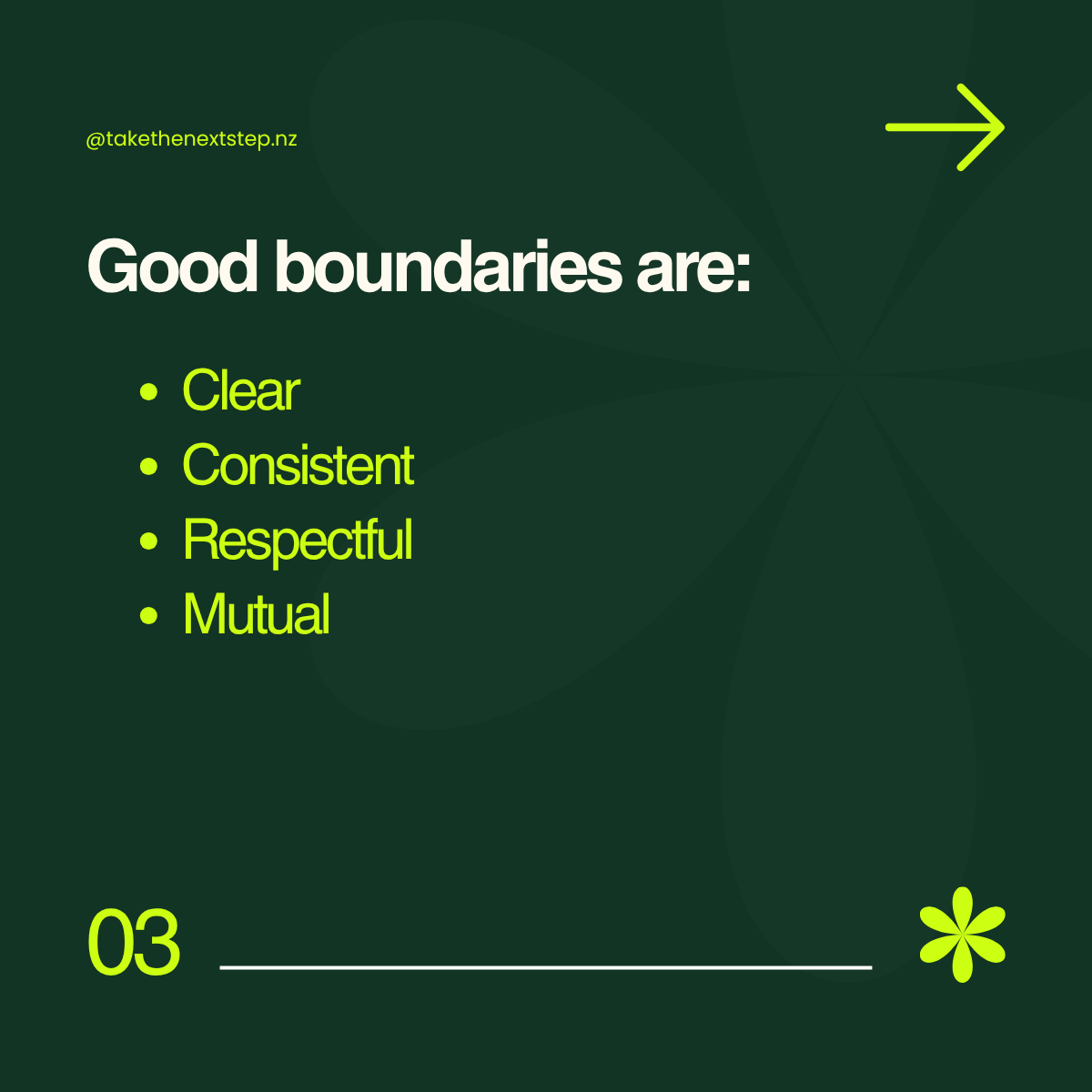
Boundaries in midlife relationships are not about controlling another person. They are about understanding what you need, what you are comfortable with, what you will accept, and what you will no longer compromise.
When life and relationships are changing, clear boundaries can provide a sense of stability while you work out what comes next.
What Are Boundaries in a Relationship?
A boundary is a clear understanding of what is acceptable and unacceptable to you within a relationship.
Boundaries can relate to:
How you communicate with each other
How you expect to be spoken to
Your time and personal space
Emotional availability
Physical intimacy
Financial matters
Parenting and family responsibilities
Contact with an ex-partner
Dating and commitment
How conflict is handled
Your need for privacy and independence
Healthy boundaries are not walls. They are a way of creating clarity around where you end and another person begins.
Why Boundaries Can Become Difficult in Midlife
Midlife relationship transitions often involve more than the relationship itself.
There may be children, shared finances, a home, friendships, family expectations, years of history and an established lifestyle to consider.
You may also be navigating grief, loneliness, guilt or uncertainty about the future.
This can make it tempting to compromise your own needs simply to keep things peaceful.
You might find yourself thinking:
"Maybe I'm asking for too much."
"I don't want to upset anyone."
"Perhaps I should just go along with it."
"I've already caused enough disruption."
But continually ignoring your own needs does not necessarily create peace. Sometimes it simply creates resentment, emotional exhaustion and confusion.
Boundaries Are Not About Being Difficult
One of the biggest misconceptions about boundaries is that setting them is selfish.
In reality, healthy boundaries can make relationships clearer and more respectful.
A boundary might sound like:
"I'm happy to discuss this, but I won't continue the conversation if we are shouting at each other."
Or:
"I need some time to think before I make that decision."
Or:
"I'm not comfortable moving that quickly in this relationship."
The purpose isn't to make the other person behave differently.
The purpose is to clearly communicate what you need and what you will choose to do if that boundary isn't respected.
That distinction is important.
Boundaries and Emotional Regulation
Boundaries are particularly important when emotions are running high.
During separation or relationship uncertainty, you may find yourself reacting quickly because you are overwhelmed, hurt or afraid of what might happen next.
Before responding, ask yourself:
What am I feeling?
What do I actually need?
What is within my control?
What boundary would support me here?
Creating a pause between the emotional trigger and your response can help you communicate from a more grounded place.
This is not about suppressing your emotions. It is about giving yourself enough space to respond intentionally rather than react automatically.
Boundaries When You Are Separating
Separation can make boundaries particularly complicated.
You may still be communicating with your former partner about children, finances, property or practical arrangements.
It can be helpful to separate practical communication from emotional communication.
For example, you may need to communicate about the children without continuing to process the relationship with your former partner.
You may also need to establish boundaries around:
When and how you communicate
Topics you are willing to discuss
Personal conversations
Social media
New relationships
Family involvement
Time and space apart
Clear boundaries can reduce unnecessary conflict and create more emotional space for you to begin rebuilding your life.
Boundaries When You Start Dating Again
Boundaries become equally important when you begin dating after separation or divorce.
You may be excited about meeting someone new, but also cautious because of what you have experienced previously.
There is no requirement to move at someone else's pace.
You are allowed to say:
"I need to take this slowly."
"I'm not ready to make that commitment yet."
"I need more time to get to know you."
"That doesn't feel right for me."
You do not need to justify every boundary.
A healthy relationship should allow space for two people to communicate their needs without fear of rejection, manipulation or punishment.
How to Identify Your Own Boundaries
If you are unsure where your boundaries are, start by paying attention to your emotional responses.
Ask yourself:
When do I feel uncomfortable?
What situations leave me feeling drained?
What behaviour consistently frustrates or upsets me?
Where do I find myself saying yes when I really mean no?
What am I tolerating because I am afraid of the consequences of speaking up?
What do I need more of in my relationships?
What do I need less of?
What would make me feel safer, calmer and more respected?
Your emotional responses can provide valuable information about where a boundary may be needed.
Boundaries Are Part of Finding Your Next Step
Midlife relationship transitions are rarely about finding one perfect answer.
They are often about gradually becoming clearer about who you are, what matters to you and what you want your next chapter to look like.
Boundaries are part of that process.
They help you move away from automatically accommodating everyone else and towards making conscious decisions about your own life.
You don't need to have everything figured out.
You can start with one boundary.
One honest conversation.
One decision to pause before responding.
One moment where you choose to listen to what you actually need.
Because finding your next step isn't about controlling what happens around you.
It's about becoming steady enough to choose how you move forward.
Need support navigating a midlife relationship transition?
If you are separating, rebuilding after divorce, questioning your relationship or finding your way into a new chapter, Take The Next Step offers structured coaching support for clarity, emotional steadiness, identity rebuilding and conscious next steps.
You don't have to figure it all out at once.
Sometimes, the next step begins with getting clear about where your boundaries are.
You are welcome to request a FREE NEXT STEP CALL

Understanding Your Triggers During a Midlife Relationship Transition
Have you ever noticed yourself reacting strongly to something and wondered afterwards, “Why did that affect me so much?”
Perhaps a delayed text message leaves you feeling rejected.
A partner becoming quiet makes you anxious.
A difficult conversation quickly turns into defensiveness.
Or something your former partner says brings up anger, sadness or insecurity that seems much bigger than the situation itself.
These experiences can be emotional triggers.
And during a midlife relationship transition — whether you are navigating separation, divorce, dating again or rebuilding your sense of identity — triggers can become particularly noticeable.
The good news is that a trigger doesn't have to control your behaviour.
Learning to recognise your triggers is an important part of developing emotional regulation, self-awareness and steadier relationship choices.
What is an emotional trigger?
A trigger is something that activates a strong emotional response.
It might be something someone says or does, a particular situation, a tone of voice, silence, rejection, criticism or even a memory.
Sometimes the response feels much bigger than the event itself.
That's because the present situation may be connecting with something deeper — perhaps a previous experience of rejection, abandonment, betrayal, criticism or feeling unheard.
The trigger isn't necessarily the whole story.
It may simply be the spark that activates an existing emotional pattern.
Why can triggers feel stronger during midlife relationship transitions?
Relationship transitions can involve significant emotional change.
You may be adjusting to:
the loss of a long-term relationship
changes to family or social dynamics
uncertainty about the future
living independently after many years with someone
rebuilding your identity
dating again after separation or divorce
questioning what you really want from a relationship
fears about repeating past experiences
When so much is changing, your emotional system can become more sensitive to perceived threats.
Something that might once have felt relatively manageable can suddenly feel much more significant.
This doesn't mean you are overreacting or that something is wrong with you.
It can simply mean that there is more emotional context sitting underneath the moment.
Common triggers after separation or divorce
Everyone's triggers are different, but some are particularly common during relationship transitions.
Silence or delayed communication
A partner doesn't respond to your message.
Your mind starts filling in the gaps.
Are they losing interest? Have I done something wrong? Are they talking to someone else?
The trigger may not actually be the delayed message.
It could be the feeling of uncertainty or rejection underneath it.
Feeling criticised
A comment from a new partner can unexpectedly bring up defensiveness.
You may find yourself wanting to justify yourself, withdraw or fight back.
Sometimes criticism can connect with previous experiences where you felt judged or not good enough.
Feeling rejected
Dating after a significant relationship can expose you to rejection in ways you haven't experienced for years.
A cancelled date, lack of interest or someone disappearing can activate feelings of inadequacy or abandonment.
Loss of control
Relationship transitions often involve uncertainty.
You may not know what your future looks like, whether a relationship will work, or what another person is thinking.
For someone who values certainty, this can become a powerful trigger.
Triggered doesn't mean broken
One of the most important shifts you can make is to stop judging yourself for having emotional responses.
Being triggered doesn't mean you are weak.
It doesn't mean you're emotionally immature.
And it doesn't necessarily mean the other person has done something terrible.
A trigger is information.
It can give you an opportunity to become curious about what is happening inside you.
Instead of:
“Why am I reacting like this?”
Try asking:
“What has this situation activated in me?”
That small change can create space between the trigger and your response.
The difference between reacting and responding
Emotional regulation doesn't mean never becoming angry, anxious, hurt or upset.
It means developing the ability to notice what is happening before automatically acting on it.
There is a difference between:
Reacting:
“I feel rejected, so I'm going to send an angry message.”
and:
Responding:
“I feel rejected right now. I'm going to pause, understand what I'm feeling and decide what I actually want to communicate.”
That pause can be powerful.
It allows you to move from emotional reflex to conscious choice.
A simple way to work with a trigger
When you notice yourself becoming emotionally activated, try slowing the process down.
1. Notice
What happened?
Try to separate the facts from the story your mind is creating.
2. Name
What are you feeling?
Anger? Fear? Sadness? Rejection? Anxiety? Shame?
Naming an emotion can help create some distance from it.
3. Explore
Ask yourself:
“What does this remind me of?”
“What am I afraid this means?”
“What do I need right now?”
4. Regulate
Before responding, give your nervous system an opportunity to settle.
Take a walk.
Breathe slowly.
Step away from the conversation.
Write down what you are feeling.
Give yourself time.
5. Choose
Once you are calmer, ask:
“How do I want to respond?”
Not:
“How do I want to react?”
That distinction can change the direction of a relationship.
Your triggers can become part of your self-awareness
The goal isn't to eliminate every trigger.
That isn't realistic.
The goal is to become increasingly aware of your patterns so that they don't automatically determine your behaviour.
Over time, you may begin to recognise:
“When someone becomes distant, I immediately assume I've done something wrong.”
Or:
“When I feel criticised, I become defensive before I have actually understood what the other person is saying.”
That awareness creates choice.
And choice is an important part of building healthier relationships in midlife.
Moving towards steadier relationships
A midlife relationship transition can be an opportunity to understand yourself differently.
You can begin to recognise old patterns without allowing them to define your future.
You can learn what activates you, what helps you regulate, what your boundaries are and what you genuinely need from a relationship.
This is not about becoming perfectly calm all the time.
It is about becoming steadier, more self-aware and more intentional in the way you respond.
Because your past may influence you.
But it doesn't have to dictate your next chapter.
Take the Next Step
If you are navigating separation, rebuilding your identity or thinking about relationships again in midlife, understanding your emotional triggers can be an important part of finding your steady ground.
The Steady Ground Path provides structured support for navigating the emotional and personal transition that can come with this stage of life.
[Explore The Steady Ground Path →]
You don't have to have everything figured out.
Sometimes the next step is simply learning to pause, understand what is happening within you, and choose your response with greater clarity.

Career Pivoting and Relationship Transitioning in Midlife: Why Grit, Tenacity and Self-Belief Matter
A midlife career pivot and a relationship transition can have more in common than you might think.
There comes a point in midlife when you may find yourself asking questions you never expected to ask.
Is this really the life I want?
What happens next?
Am I brave enough to start again?
For some people, those questions arise because a long-term relationship has changed or ended. For others, they emerge because their career no longer feels aligned with who they are becoming.
And sometimes, both happen at once.
Whether you're navigating a midlife relationship transition, separation, divorce, or a career pivot, the experience can challenge your sense of identity, confidence and direction.
It can feel like you're standing at the edge of something new without being completely sure what that new chapter looks like.
Midlife can be a time of reassessment
One of the challenges of midlife is that you've often spent decades building a life around certain roles and responsibilities.
You may have been a partner, parent, business owner, professional, caregiver or provider.
Those identities can become deeply intertwined with how you see yourself.
So when one of them changes, it isn't simply a practical adjustment.
It can raise a much bigger question:
Who am I now?
A career pivot can bring exactly the same uncertainty.
You may know that your current career no longer feels right, but that doesn't necessarily mean you know what you want to do instead.
The same can be true after separation.
Knowing that your old relationship isn't right for your next chapter doesn't automatically tell you what your future should look like.
That space between what was and what comes next can be uncomfortable.
But it can also be incredibly important.
Career pivoting in midlife takes more than a good plan
A career change after 40 can require courage.
You may have to learn new skills, rebuild your confidence, explain your experience differently or step into an environment where you aren't the expert you once were.
There can be moments when you wonder:
Am I too old to start again?
Will anyone take me seriously?
What if I fail?
What if I've made the wrong decision?
These thoughts don't necessarily mean you're making the wrong choice.
Sometimes they simply mean you're doing something unfamiliar.
And unfamiliar territory requires something more than motivation.
It requires grit and tenacity.
Relationship transitions require those qualities too
The same is true when you're rebuilding your life after separation or divorce.
There may be days when you feel clear and confident.
Then another day arrives and you're questioning everything.
You may be rebuilding your routines, finances, social life, identity and vision for the future.
You may also be wondering whether you want another relationship — and, if you do, what a healthier relationship might look like this time.
Progress isn't always linear.
There can be setbacks. There can be doubt.
There can be moments when going back to what is familiar feels easier than continuing forward.
This is where grit matters.
Not as a determination to simply push through everything.
But as the willingness to keep taking the next step, even when the path isn't completely clear.
Believe in yourself before you have all the answers
One of the hardest parts of making a significant change in midlife is that you may be waiting to feel completely confident before you act.
But confidence doesn't always come first. Sometimes confidence is built through action.
You take one step. You learn something. You survive something that once frightened you.
You discover that you're more capable than you thought.
Then you take another step. Your belief in yourself grows through evidence.
This is particularly important when your previous identity has been shaken by a relationship ending or a career change.
You don't have to have your entire future mapped out. You need enough belief in yourself to begin.
Grit doesn't mean doing everything alone
There is another important distinction.
Being resilient doesn't mean you have to do everything by yourself.
Sometimes tenacity looks like asking for help.
It might mean talking to a career professional, coach, counsellor or trusted person who can help you see your situation differently.
It might mean creating a structured plan rather than trying to solve your entire future in your head.
And sometimes it means giving yourself permission to slow down long enough to work out what you actually want.
Strength isn't always about pushing harder.
Sometimes strength is recognising what support you need.
Your next chapter doesn't have to look like your last one
A midlife transition can feel like an ending. But it can also be an opportunity to reassess.
You can ask:
What matters to me now?
What have I outgrown?
What do I want more of in my life?
What do I no longer want to carry forward?
What would a fulfilling next chapter look like?
What is one small step I can take towards it?
You don't need to reinvent your entire life overnight. You don't need to know exactly where you'll be in five years.
You simply need to be willing to take the next step. And then another.
Grit. Tenacity. Self-belief.
These qualities don't mean you won't experience fear or uncertainty.
They mean you don't allow those feelings to make every decision for you.
Your midlife transition may not be the chapter you expected.
But that doesn't mean it can't become one of the most meaningful chapters of your life.
You are not starting from scratch.
You're starting from experience. And sometimes, that's a much stronger place to begin.
If you're navigating a significant change in midlife and feeling uncertain about what comes next,
a Next Step Call can give you space to talk through where you are, what you're considering and what your next step could look like.

How to Find Balance During Midlife Separation
Separation in midlife can feel like your life has been turned upside down.
There may be decisions about your relationship, home, finances, family, work and your future — all happening at the same time.
And while you're trying to work out what comes next, you may also be dealing with grief, uncertainty, anger, loneliness or relief.
Finding balance during midlife separation isn't about having everything figured out.
It's about learning how to stay grounded while your circumstances are changing.
Why separation can feel particularly challenging in midlife
Midlife separation can involve more than the end of a relationship.
You may have spent many years building a shared life, creating routines, raising children, managing finances and developing an identity around your relationship and family.
When that structure changes, it can leave you asking:
Who am I now?
What do I actually want?
Where will I live?
What will my future look like?
Will I ever feel settled again?
These questions can make it difficult to know where to focus your energy.
You don't need to solve all of them at once.
In fact, trying to do so can make an already difficult transition feel even more overwhelming.
What does balance during separation actually mean?
Balance doesn't mean feeling calm every day.
You may have days when you feel strong and hopeful, followed by days when you feel completely unsettled.
That's normal.
Balance means creating enough stability around you that you can experience those emotions without allowing them to completely take over.
It means giving attention to both your practical needs and emotional wellbeing.
And it means making space for your future without rushing yourself to know exactly what that future looks like.
1. Separate what you can control from what you can't
One of the most exhausting parts of separation is trying to control things that aren't actually within your control.
You can't control how your former partner responds.
You can't control exactly how quickly you will feel better.
You can't control what other people think.
But you can control how you communicate, the boundaries you establish, the support you seek and the decisions you make from this point forward.
When you feel overwhelmed, ask yourself:
“What is actually within my control today?”
Then focus your energy there.
2. Don't make every decision at once
Separation can create a sense that you need to work everything out immediately.
But not every decision is urgent.
Some decisions require information.
Some require time.
And some require you to become clearer about what you actually want.
Try separating your decisions into three categories:
Now: What genuinely needs my attention today?
Soon: What needs consideration over the next few weeks?
Later: What can wait until I have more clarity?
This simple distinction can reduce the feeling that your entire future needs to be solved immediately.
3. Create some stability in your daily life
When your relationship is changing, small routines can become surprisingly important.
Regular meals.
Movement.
Sleep routines.
Time outside.
Work.
Friends.
Activities that remind you that you are still a whole person outside your relationship.
These things may seem ordinary, but they provide structure while other parts of your life are uncertain.
You don't need to transform your life overnight.
Start by creating a few dependable points in your week.
4. Give your emotions somewhere to go
Trying to stay positive all the time isn't balance.
Neither is allowing difficult emotions to consume every part of your day.
Give yourself somewhere safe to process what you're feeling.
That might be talking with someone you trust, journalling, working with a coach or counsellor, walking, or simply creating quiet time to reflect.
The goal isn't to eliminate difficult emotions.
It's to understand them without letting them make every decision for you.
5. Be careful about making major decisions from a place of emotional overwhelm
When emotions are running high, it can be tempting to make big decisions simply to escape the discomfort.
You might want to immediately sell everything, move somewhere new, start dating again or completely reinvent your life.
Sometimes change is exactly what you need.
But before making a major decision, ask:
“Am I moving towards something I genuinely want, or am I trying to get away from how I feel right now?”
That distinction can be incredibly valuable during separation.
6. Reconnect with who you are outside the relationship
One of the quieter challenges of midlife separation is identity.
For years, your life may have revolved around being a partner, parent, provider, homemaker or part of a family unit.
Now you may have an opportunity to rediscover parts of yourself that have been neglected.
What interests you?
What gives you energy?
What values matter most to you now?
What kind of life would feel meaningful?
You don't need to have all the answers.
Rebuilding your identity is a process.
7. Don't rush into your next chapter
There can be pressure after separation to “move on”.
Sometimes that means dating.
Sometimes it means proving that you're okay.
Sometimes it means creating a completely new life as quickly as possible.
But moving forward doesn't have to mean moving quickly.
Your next chapter deserves to be built from clarity rather than urgency.
Especially in midlife, you have an opportunity to become more intentional about the life and relationships you choose.
8. Build a support system that helps you stay grounded
You don't have to navigate separation alone.
But it's worth being thoughtful about who you turn to.
Some people will encourage you to leave immediately.
Others may encourage you to reconcile.
Others may simply project their own experiences onto yours.
What you may need most is someone who can help you think clearly without telling you what decision to make.
Good support doesn't take away your agency.
It helps you reconnect with it.
Finding your balance isn't about having all the answers
Midlife separation can be a significant life transition.
There may be grief for what you've lost, uncertainty about what comes next and excitement about possibilities you haven't yet considered.
You don't need to know exactly where you're going.
You need enough steadiness to take the next step.
That might be establishing a new routine.
Having a difficult conversation.
Setting a boundary.
Getting professional support.
Taking time to understand what you want.
Or simply giving yourself permission not to have everything figured out yet.
Balance isn't about standing still.
It's about being grounded enough to move forward thoughtfully.
If you're navigating separation in midlife
If you're several months into separation and still feel unsettled about what comes next, you don't necessarily need more advice.
You may need space to step back, understand what's happening, reconnect with yourself and work out what your next chapter could look like.
At Take The Next Step, coaching provides structured support for people navigating midlife relationship transitions, identity changes and the decisions that come with them.
You don't have to have your whole future worked out.
You just need to find your next step.

How to Get Clarity in a Relationship When You Feel Unsure
There are times in a relationship when you simply don't know what you want.
You may still care deeply about your partner, but something doesn't feel right.
You might find yourself asking:
Do I still want this relationship?
Am I unhappy with my relationship, or am I just going through a difficult period?
Should I stay and work on things, or is it time to move on?
Why can't I seem to make a decision?
When you're caught between staying and leaving, it can be tempting to search for a definitive answer.
But relationship clarity rarely arrives as one sudden realisation.
More often, clarity develops when you slow down, separate your feelings from your fears, and become willing to honestly look at what is happening.
What does clarity in a relationship actually mean?
Relationship clarity doesn't necessarily mean knowing immediately whether you should stay or leave.
It means becoming clearer about:
what you are feeling
what you need
what is and isn't working
what you want from a relationship
what you are willing to accept
what you are no longer willing to compromise
and what your possible next steps might be
You don't need to have the entire future figured out.
Sometimes clarity simply means being able to say:
"This is where I am right now, and this is what I need to understand next."
Why is it so difficult to get clarity?
There may be love, history, family, finances, shared experiences and genuine care for another person.
There may also be disappointment, resentment, fear, loneliness or uncertainty.
And when all of these emotions are present at the same time, it's easy to become overwhelmed.
You might find yourself going around in circles:
Think → doubt → analyse → worry → decide → second-guess → repeat.
This can create the illusion that you need to think more to find your answer.
Sometimes you actually need to step out of the constant thinking.
1. Start with what you know, rather than what you fear
When you're uncertain, your mind can quickly jump into the future.
"What if I leave and regret it?"
"What if I stay and nothing changes?"
"What if I'm making a terrible mistake?"
These questions can be useful, but they can also keep you stuck.
Instead, begin with what you know.
Ask yourself:
What is happening in my relationship right now?
What feels good?
What feels difficult?
What has changed?
What have I been tolerating that no longer feels okay?
What have I been missing?
Facts and observations can give you somewhere solid to begin.
2. Separate your feelings from your decision
You can feel unhappy without knowing whether you want to leave.
You can love someone and still question the relationship.
You can be angry and still care.
You can be lonely within a relationship.
And you can be frightened of leaving without actually wanting to stay.
Feelings are important information, but they don't always provide the entire answer.
Rather than asking:
"What should I do?"
try asking:
"What are my feelings telling me?"
This creates space between the emotion you're experiencing and the decision you're trying to make.
3. Ask yourself what you actually need
Sometimes relationship uncertainty isn't really about the relationship itself.
It may be about an unmet need.
Perhaps you need:
more emotional connection
better communication
greater independence
affection
respect
honesty
shared goals
space
companionship
reassurance
or simply to feel seen and heard
Ask yourself:
"If this relationship were meeting my most important needs, what would be different?"
Your answer may reveal something important.
4. Look at the relationship as it is — not only as you hope it could be
Hope can be powerful.
But when you're trying to find clarity, it's important to distinguish between potential and reality.
Ask:
What is actually happening?
What has genuinely changed?
What have I been hoping will change?
Have we both been willing to work on the relationship?
Am I responding to the relationship I have, or the relationship I wish I had?
This isn't about becoming negative or giving up.
It's about seeing the relationship honestly.
5. Notice the difference between fear and intuition
Fear can be loud.
It can tell you:
"Don't make a mistake."
"What if you're wrong?"
"What will everyone think?"
"What if you end up alone?"
Intuition can be quieter.
It may feel more like:
"Something here isn't right."
"I know this isn't sustainable for me."
"I need to pay attention to this."
Learning to distinguish fear from your deeper knowing takes time.
You don't have to act on every feeling immediately.
Instead, get curious about it.
6. Stop demanding an immediate answer
One of the biggest obstacles to relationship clarity is the belief that you have to decide everything now.
You don't necessarily have to.
Sometimes the next right step isn't:
Stay or leave.
It might be:
Have an honest conversation.
Or:
Set a boundary.
Or:
Take some space.
Or:
Get support.
Or:
Give yourself time to observe what happens.
Clarity often comes through small next steps, rather than one enormous decision.
7. Ask better questions
If you've been asking yourself:
"Should I stay or should I leave?"
and getting nowhere, try asking different questions.
Try these:
What am I most unhappy about?
What am I most afraid of losing?
What do I want my relationship to feel like?
What do I need that I'm currently not receiving?
What would need to change for me to genuinely want to stay?
Have I communicated those needs clearly?
What happens when I imagine staying for another five years?
What happens when I imagine life after leaving?
Which possibility creates fear — and which creates a sense of relief?
You may not get an immediate answer.
But you may begin to notice patterns.
And patterns can create clarity.
What if you're still unsure?
Sometimes you can do all the thinking, journalling and talking you can manage — and still feel uncertain.
That doesn't mean you're failing.
It may simply mean there are several competing truths inside you.
You may love your partner and know that something needs to change.
You may want freedom and still fear being alone.
You may want the relationship to work while also recognising that you cannot continue exactly as things are.
These contradictions don't make you confused or irrational.
They make you human.
The goal isn't necessarily to eliminate every uncertainty.
The goal is to become grounded enough to make decisions from awareness rather than fear, pressure or overwhelm.
Clarity doesn't always tell you what to do
This is perhaps the most important thing to remember.
Clarity isn't always a sign saying "stay."
And it isn't always a sign saying "leave."
Sometimes clarity simply helps you understand:
"This is what I feel."
"This is what I need."
"This is what I can and cannot accept."
"This is what needs to change."
And from there, you can decide what your next step needs to be.
You don't have to figure out your entire future today.
You just need enough clarity to take the next step.
If you're struggling to find clarity
If you're at a point where you're constantly questioning your relationship, replaying conversations or feeling stuck between staying and leaving, having a calm, structured conversation with someone outside the situation can help.
At Take The Next Step, I work with people navigating relationship transitions, separation and the uncertainty that can come before a major life decision.
The focus isn't on telling you whether you should stay or leave.
It's about helping you slow down, understand what's really going on, reconnect with what matters to you and identify your next step.
You don't have to have all the answers before you begin.
Sometimes you just need enough clarity to take the next step.
"When You're Not Ready to Leave, But You Can't Stay the Same"

How to Stop Overthinking After a Breakup or Divorce
After a breakup or divorce, your mind can become a place you don't seem to be able to switch off.
You replay conversations.
You question decisions.
You wonder what your ex is thinking.
You analyse what went wrong — and what you could have done differently.
Then, just when you think you've made some progress, another thought arrives:
“What if I made the wrong decision?”
Overthinking after separation is incredibly common. Your life has changed, your sense of certainty may have disappeared, and your brain is trying to make sense of what happened.
The problem is that thinking harder doesn't necessarily create clarity.
Sometimes, it simply keeps you stuck in the same emotional loop.
Why do we overthink after a breakup or divorce?
When a significant relationship ends, there are often many unanswered questions.
You may be grieving the relationship you had, the future you imagined, or the person you thought you would grow old with.
There may also be practical uncertainty around finances, family, children, living arrangements and your future.
Your mind naturally wants answers.
It wants to understand:
What went wrong?
Could I have prevented this?
Did I make the right decision?
Does my ex still care?
Will I ever feel happy again?
Will I find someone else?
What happens next?
Some reflection can be helpful.
But there is a difference between reflection and rumination.
Reflection helps you understand.
Rumination keeps you circling.
1. Notice when you're overthinking
The first step isn't trying to stop every thought.
It's noticing what is happening.
You might catch yourself replaying the same conversation for the tenth time or imagining different versions of how things could have turned out.
Instead of immediately following the thought, pause and say:
“I'm overthinking this right now.”
That small moment of awareness creates some distance between you and the thought.
You don't have to solve it immediately.
2. Separate what you know from what you are assuming
After separation, it is easy for facts and assumptions to become tangled together.
For example:
Fact: Your relationship has ended.
Thought: “I'll never have a relationship like that again.”
Fact: Your ex hasn't responded to your message.
Thought: “They must not care about me anymore.”
The thought may feel completely real, but it isn't necessarily a fact.
Try asking yourself:
“What do I actually know — and what am I filling in?”
This can be surprisingly powerful.
3. Stop trying to solve the past
There is a point where analysing the past stops being useful.
You may never know exactly why your relationship unfolded the way it did.
You may never receive the apology you hoped for.
You may never understand every decision your former partner made.
And you may never be able to identify the one moment when everything changed.
That doesn't mean you cannot heal.
Sometimes moving forward means accepting that you have learned enough from the past.
You don't need every answer before you can take your next step.
4. Give your thoughts somewhere to go
Trying to suppress thoughts often makes them louder.
Instead, give yourself a defined space to process them.
You could keep a journal and write down:
What am I thinking?
What am I feeling?
What am I afraid might happen?
What do I actually need right now?
Then finish with:
“What is one thing I can control today?”
This moves you from endless mental processing towards something more grounded and constructive.
5. Create boundaries around checking
Overthinking is often fuelled by behaviours such as repeatedly checking:
your ex's social media
messages
online activity
old photographs
previous conversations
dating apps
mutual friends' updates
Each check may give you a moment of relief or curiosity.
But it can also restart the emotional cycle.
Consider asking yourself:
“Is this helping me move forward, or keeping me emotionally connected to the past?”
You don't have to make every boundary permanent.
But you may need enough space to allow your nervous system and your thoughts to settle.
6. Bring yourself back to the present
Overthinking often takes you into two places:
the past — “What if I had...?”
or
the future — “What if...?”
Neither place is where your life is actually happening.
When you notice your mind racing, bring your attention back to today.
Ask:
“What do I need today?”
Maybe it's a walk.
A conversation with someone you trust.
A proper meal.
Time outside.
Work that gives you purpose.
Rest.
Or simply an evening without trying to figure everything out.
Small acts of stability matter.
7. Don't confuse uncertainty with a wrong decision
One of the hardest parts of separation can be living with uncertainty.
You may think:
“If I were making the right decision, I wouldn't feel this unsure.”
But uncertainty doesn't necessarily mean you've made the wrong choice.
It may simply mean you're experiencing a significant life transition.
You can miss someone and still know the relationship wasn't right for you.
You can feel lonely and still know you need space.
You can question your decision and still continue moving forward.
Two seemingly conflicting feelings can exist at the same time.
8. Start asking better questions
Instead of repeatedly asking:
“Why did this happen?”
try asking:
“What is this experience teaching me about myself?”
Instead of:
“Will I ever find love again?”
try:
“What kind of relationship would feel healthy for me in the future?”
Instead of:
“How do I get my old life back?”
try:
“What do I want my next chapter to look like?”
The questions you ask yourself can change the direction of your thinking.
You don't need to figure out your whole future right now
After a breakup or divorce, there can be enormous pressure to know what comes next.
Should you date?
Should you stay single?
Should you move?
Should you reconnect?
Should you start again somewhere completely different?
You don't necessarily need all the answers today.
Sometimes the next step isn't about making a huge decision.
It's about finding enough steadiness to make the next right decision.
Clarity often comes through movement, reflection and time — not through thinking about the same question for another three hours.
Moving from overthinking to steady ground
Your thoughts aren't the enemy.
They are often trying to protect you, understand what happened and prepare you for what comes next.
But you don't have to believe every thought.
And you don't have to solve every uncertainty before you move forward.
The goal isn't to never think about your breakup or divorce again.
The goal is to reach a place where the past no longer occupies all of your mental space.
Where you can reflect without becoming consumed.
Where you can acknowledge what happened without allowing it to define what happens next.
And where you can begin to ask a different question:
“What do I want my life to look like from here?”
That is where rebuilding begins.
If you're ready to take the next step
You don't have to navigate the transition from separation to your next chapter completely on your own.
At Take The Next Step, I provide calm, structured coaching for people navigating midlife relationship transitions — helping you move from uncertainty and emotional overwhelm towards greater clarity, confidence and a sense of direction.
You don't need to have your whole future figured out.
You just need to be ready to take the next step.

The 7 Biggest Mistakes People Make After Separation
Separation can leave you standing in unfamiliar territory.
The relationship has changed. Your routines may have changed. Your identity may feel different. And suddenly, decisions that once seemed straightforward can feel surprisingly difficult.
There is no perfect way to navigate separation. Everyone's circumstances are different.
But there are some common patterns that can make the transition harder than it needs to be.
Here are seven of the biggest mistakes people make after separation — and what you can do instead.
1. Rushing to rebuild your life before you've had time to process what happened
One of the most common responses to separation is the urge to move forward quickly.
You might throw yourself into work, start dating, make major lifestyle changes, or immediately begin planning your "new life."
Moving forward is important. But moving forward and moving on are not necessarily the same thing.
If you haven't had time to understand what you've experienced, you can end up carrying unresolved grief, anger, fear or confusion into your next chapter.
Instead: Give yourself permission to pause.
Ask yourself:
What am I actually feeling?
What have I lost?
What have I learned?
What do I need now that I didn't need before?
You don't need to have all the answers immediately.
2. Making your next relationship part of your recovery plan
After separation, companionship can feel incredibly appealing.
You may miss intimacy, connection, affection or simply having someone beside you.
There's nothing wrong with wanting a relationship again.
The difficulty comes when a new relationship becomes a way of escaping loneliness, proving that you're still desirable, or avoiding the discomfort of being alone.
A new relationship can't do the work of rebuilding your relationship with yourself.
Instead: Before asking "Who should I date next?", spend some time asking:
"Who am I becoming?"
The stronger your sense of self becomes, the more likely you are to choose your next relationship from clarity rather than from need.
3. Defining yourself by what happened
Separation can easily become part of your identity.
"I'm divorced."
"My marriage failed."
"I've been left."
"I wasted years of my life."
These statements may describe something that happened to you, but they don't have to define who you are.
Your relationship ending is part of your story — not the whole story.
Instead: Start looking beyond what has ended.
What qualities have you developed?
What matters to you now?
What did the experience teach you about yourself?
What do you want your next chapter to look and feel like?
Rebuilding your identity isn't about becoming someone completely different.
It's about reconnecting with yourself.
4. Making major decisions from a place of emotional overwhelm
Separation can create a powerful desire for certainty.
You may want to know immediately:
Should I date?
Should I move?
Should I sell the house?
Should I change careers?
Should I try to reconcile?
Some decisions need to be made quickly. Others don't.
When emotions are running high, however, it's easy to make decisions simply because you desperately want the uncertainty to stop.
Instead: Where possible, create some breathing room between the emotion and the decision.
Ask:
"Am I making this decision because it feels right — or because I need the discomfort to end?"
That small pause can make a significant difference.
5. Comparing your recovery to everyone else's
Someone you know may seem to have "moved on" within months.
They may be dating again, travelling, buying a new home or posting photos of an exciting new life.
Meanwhile, you may still be figuring out who you are.
It's easy to wonder:
"What's wrong with me?"
Nothing.
There is no universal timeline for rebuilding after separation.
Some people process their emotions quickly. Others need more time. Some relationships end gradually; others end suddenly. Some separations involve children, financial complexity or years of shared history.
Instead: Measure your progress against where you were, not where someone else appears to be.
Progress might simply mean:
"I'm beginning to feel like myself again."
That's progress.
6. Holding onto the past because the future feels uncertain
Sometimes people remain emotionally attached to the old relationship because the alternative feels frightening.
Even when you know the relationship wasn't right for you, letting go can mean letting go of familiarity, routines, shared dreams and the future you once imagined.
That can be incredibly difficult.
But holding onto an old version of your life doesn't necessarily make the uncertainty of the future disappear.
Instead: Allow yourself to grieve what you thought your life would be — while gradually becoming curious about what could come next.
You don't need to know exactly where you're going.
You only need to identify your next step.
7. Believing you need to have everything figured out before you can feel okay
This might be the biggest mistake of all.
You don't need a five-year plan.
You don't need to know whether you'll find another partner.
You don't need to know exactly what your new life will look like.
And you certainly don't need to have completely "healed" before you start rebuilding.
Sometimes clarity comes through taking small steps, rather than waiting for clarity to arrive first.
Start with what you can control.
Your routines.
Your boundaries.
Your friendships.
Your wellbeing.
Your environment.
Your relationship with yourself.
Then take the next step.
Separation isn't just about what you're leaving behind
Separation can be an ending.
But it can also become a period of significant personal change.
The goal isn't to erase your past or pretend that the relationship didn't matter.
It's to understand what happened, reconnect with who you are now, and gradually create a life that feels authentic to you.
You don't have to rush.
You don't have to have all the answers.
You just need somewhere to begin.
And sometimes, the most important step is simply deciding to take the next one.

What Is the Difference Between Separation Coaching, Counselling, and Therapy?
When a relationship ends, one of the biggest questions people ask is:
"What kind of support do I actually need?"
You may have heard about separation coaching, counselling, and therapy, but understanding the differences can feel confusing.
The truth is that each offers valuable support. The right choice depends on where you are in your journey and what you hope to achieve.
Separation Coaching
Separation coaching is a future-focused approach that helps you navigate the practical and emotional challenges of life after separation.
Rather than focusing primarily on why the relationship ended, coaching helps you identify where you are today, where you want to be, and the steps that will help you move forward.
A separation coach may help you:
- Rebuild confidence after separation
- Clarify your next steps
- Strengthen healthy boundaries
- Navigate dating after separation
- Rediscover your identity
- Create a meaningful vision for your future
- Develop practical strategies for moving forward
Coaching is collaborative and action-oriented. It's about helping you move from surviving to thriving.
Counselling
Counselling provides a safe and supportive environment to explore difficult emotions, life experiences, grief, and personal challenges.
A counsellor helps you understand your thoughts and feelings, develop coping strategies, and process significant life events.
Counselling can be particularly helpful if you're:
- Experiencing grief after separation
- Feeling overwhelmed by change
- Working through relationship difficulties
- Looking for emotional support during a challenging period
Many people find counselling invaluable while adjusting to major life transitions.
Therapy
Therapy often explores deeper emotional patterns, past experiences, trauma, or mental health concerns that may be affecting your wellbeing today.
Therapists are trained to assess and treat a range of psychological conditions using evidence-based approaches.
Therapy may be appropriate if you're experiencing persistent anxiety, depression, unresolved trauma, or other mental health challenges that require clinical support.
Which Is Right for You?
There isn't a one-size-fits-all answer.
Some people begin with counselling or therapy before moving into coaching. Others may work with different professionals at different stages of their journey.
If you're looking to process deep emotional wounds or address mental health concerns, counselling or therapy may be the best place to start.
If you're ready to rebuild your confidence, regain direction, and create a meaningful next chapter, separation coaching may be the right fit.
In many cases, these forms of support complement one another rather than compete.
How I Work at Take The Next Step
At Take The Next Step, I offer separation coaching for adults navigating relationship transitions in midlife.
My coaching is designed for people who are ready to move forward with greater clarity, confidence, and purpose.
Together we'll explore where you are today, identify what's keeping you feeling stuck, and develop practical steps towards the life you want to create.
Coaching is not counselling or therapy, and it is not a replacement for mental health care. If I believe another form of support would better meet your needs, I will always encourage you to seek the most appropriate professional support.
Your Next Chapter Starts With One Step
The end of a relationship can leave you feeling uncertain about the future.
Whatever support you choose, you don't have to face this transition alone.
With the right guidance, healing is possible, confidence can be rebuilt, and a fulfilling new chapter can begin.
If you're wondering whether separation coaching is right for you, I invite you to book a complimentary Next Step Call. Together we can explore where you are now and whether coaching is the right next step for you.

Separation Coaching in New Zealand: Finding Your Way Forward After a Relationship Ends
Separation is one of life's most significant transitions.
Whether your relationship ended unexpectedly, you made the difficult decision to leave, or you're still navigating uncertainty, it can feel as though the future has disappeared overnight. Alongside the emotional pain often comes confusion, self-doubt, grief, anxiety, and the overwhelming task of rebuilding your life.
The good news is that you don't have to navigate this journey alone.
Separation coaching offers practical, structured support to help you regain clarity, rebuild confidence, and move forward with purpose.
What Is Separation Coaching?
Separation coaching is a future-focused form of personal support that helps people navigate the emotional and practical challenges following the end of a relationship.
Unlike therapy, which often explores past trauma or treats mental health conditions, separation coaching focuses on helping you move from where you are today towards the life you want to create next.
A separation coach can help you:
Process the emotional impact of separation
Regain confidence and self-worth
Navigate major life decisions
Establish healthy boundaries
Reduce overwhelm and uncertainty
Rebuild your identity outside the relationship
Prepare for healthy future relationships
Coaching provides a safe, confidential space where you can reflect, gain perspective, and take meaningful action.
Why Separation Can Feel So Overwhelming
The end of a long-term relationship affects every area of life.
You may be adjusting to living alone, navigating co-parenting, managing finances differently, or wondering who you are without your previous relationship.
Many people experience:
Grief and sadness
Anxiety about the future
Loss of confidence
Loneliness
Fear of dating again
Difficulty trusting others
Feeling stuck between the past and the future
These emotions are completely understandable. Healing isn't about "getting over it" quickly—it's about moving through the experience in a healthy, intentional way.
Separation in New Zealand
Every separation is unique, but many New Zealanders also face practical decisions involving children, finances, property, or legal processes. Government information explains the legal aspects of separation and divorce, while emotional support is equally important during this transition.
Coaching does not replace legal, financial, or mental health professionals. Instead, it complements them by helping you remain calm, make thoughtful decisions, and move forward with greater confidence.
Signs You May Benefit From Separation Coaching
You might benefit from coaching if you:
Feel emotionally stuck months after your separation.
Keep replaying the past.
Have lost confidence in yourself.
Don't know what your next chapter looks like.
Feel anxious about dating again.
Want healthier relationships in the future.
Need support making important life decisions.
Want to rebuild your life with purpose.
Many people seek coaching between six months and several years after separation, once the initial crisis has passed but they still feel they haven't truly moved forward.
What Happens During Separation Coaching?
At Take The Next Step, coaching follows a calm, structured approach designed to help you move forward with confidence.
Reflect
Together we explore your relationship patterns, beliefs, emotional triggers, and experiences to understand what has shaped your journey.
Release
We work through unresolved emotions, limiting beliefs, and fears that may be preventing you from moving forward.
Rediscover
This stage focuses on rebuilding confidence, reconnecting with your values, strengthening boundaries, and creating a meaningful future.
Rather than simply surviving separation, you'll begin creating a life that feels aligned with who you are becoming.
What Results Can You Expect?
While every person's journey is different, many clients begin to experience:
Greater emotional stability
Increased confidence
Better decision-making
Healthier boundaries
Improved self-awareness
Reduced anxiety
Hope for the future
Readiness for new relationships when the time is right
Healing doesn't mean forgetting your past.
It means no longer allowing it to define your future.
Why Choose Take The Next Step?
At Take The Next Step, I provide gentle, practical coaching for adults navigating relationship transitions in midlife.
My approach is calm, compassionate, and structured. Together, we'll work at a pace that feels right for you while helping you regain clarity, confidence, and emotional stability.
You don't have to have everything figured out before reaching out.
Sometimes the next step is simply having a conversation.
Ready to Take Your Next Step?
If you're feeling stuck after separation and would like calm, supportive guidance, I'd love to help.
Book a complimentary Next Step Call to explore where you are now, where you'd like to be, and whether coaching is the right fit for you.
The end of one relationship doesn't have to be the end of your story.
With the right support, it can become the beginning of your strongest chapter yet.

When You're Not Ready to Leave, But You Can't Stay the Same
There is a season many women experience that few people talk about. A season that exists somewhere between acceptance and action.
Between comfort and change. Between staying and leaving.
It often begins with a quiet realisation: "I can't keep living exactly as I have been. "Yet at the same time: "I'm not ready to leave."
This can be one of the most confusing and emotionally exhausting places to find yourself.
Because while the world tends to view relationships in black and white, many women are living in the grey.
The Pressure to Choose
When relationship challenges surface, people often expect quick decisions.
Stay or leave. Fight or walk away. Work on it or end it.
But real life is rarely that simple.
Many women are not trying to decide whether a relationship should end.
They are trying to understand what they need. They are trying to understand themselves.
And that process takes time.
The pressure to rush towards certainty can actually make clarity harder to find.
The Relationship Isn't the Only Thing Changing
Often, what feels like a relationship problem is also a personal transformation.
Midlife brings enormous shifts. Perimenopause and menopause.
Changing family dynamics. Career transitions.
Children becoming independent.
A deeper awareness of mortality and time. Questions around purpose and fulfilment.
Many women begin recognising that the life they built no longer fully reflects the person they have become.
This doesn't automatically mean the relationship is wrong.
It does mean something important is asking for attention.
You Don't Need to Leave to Change
One of the biggest misconceptions women hold is that change requires ending a relationship.
Sometimes it does.
But often meaningful change begins long before that point.
You can change how you communicate. You can establish boundaries.
You can prioritise your wellbeing. You can ask for support.
You can become more honest about your needs. You can stop abandoning yourself.
The first person who often needs permission to change is you.
Reclaiming Yourself
Many women reach this stage and realise they have spent years adapting.
Keeping the peace. Managing everyone's emotions. Meeting expectations. Putting their needs last.
The thought of prioritising themselves can feel uncomfortable, even selfish.
Yet reclaiming yourself is not selfish. It is necessary.
Healthy relationships require two whole people.
Not one person carrying the emotional weight of everyone around them.
Living With Uncertainty
Perhaps the hardest part of this journey is accepting that you may not know the outcome immediately.
You may not know whether the relationship will evolve. You may not know what the future holds.
You may not know what decision you will ultimately make. And that's okay.
Uncertainty is uncomfortable, but it is also where growth happens.
Not every question needs an immediate answer.
Sometimes clarity arrives through small steps rather than dramatic decisions.
The Next Step
If you're not ready to leave, but you know you can't stay the same, you are not failing. You are growing.
Growth often begins long before external circumstances change.
It begins when you become honest about what you're feeling.
When you stop dismissing your needs.
When you start paying attention to the quiet voice within that says: "There has to be more than this."
You do not need to know exactly where the path leads. You only need enough courage to take the next step.
And sometimes, that next step is simply choosing yourself again.
If this resonates with you, and you would like to chat, reach out for a FREE ‘Next Step’ Call

The Grief of Outgrowing a Relationship
When we think about grief, we often associate it with endings.
The end of a marriage.
The end of a relationship.
The loss of a loved one.
The loss of a job, a dream, or a future we once imagined.
But there is another form of grief that receives far less attention.
The grief that arises when you begin to outgrow a relationship.
Not because anyone has done something wrong.
Not because there has been a dramatic betrayal.
But because you are no longer the same person you once were.
A Quiet Kind of Grief
This grief often arrives slowly.
You may notice a growing sense of restlessness.
A feeling that something no longer fits.
A longing for deeper connection, greater authenticity, or a different way of living.
At first, you may dismiss these feelings.
You may tell yourself to be grateful.
You may focus on everyone else's needs.
You may try harder to make things feel the way they once did.
Yet the feeling remains.
Not because you are ungrateful.
But because growth has begun.
Mourning More Than a Relationship
When women experience this kind of grief, they are often mourning several things at once.
The relationship they hoped would evolve.
The future they imagined.
The version of themselves who was content with less.
The years invested.
The certainty they once felt.
Even if the relationship remains intact, there can be a profound sense of loss.
Loss of familiarity.
Loss of expectations.
Loss of the story you thought your life would follow.
Why Midlife Often Brings This Into Focus
Midlife has a way of creating clarity.
As children grow older, careers stabilise, and life experience accumulates, many women begin asking deeper questions.
Who am I now?
What matters most to me?
Am I living in alignment with my values?
What do I want the next chapter of my life to look like?
These questions are not signs of selfishness.
They are signs of self-awareness.
And sometimes the answers reveal gaps between who you have become and the relationship dynamics that once felt acceptable.
Giving Yourself Permission to Feel
One of the hardest parts of this experience is allowing yourself to acknowledge the grief.
Many women judge themselves for having these feelings.
They tell themselves they should be happy.
They compare their situation to others.
They minimise their experience.
Yet grief does not require permission from anyone else.
If something important is changing, grief is a natural response.
Acknowledging it does not mean you have made a decision.
It simply means you are honouring your reality.
Growth and Uncertainty Can Coexist
You do not need to know exactly what comes next.
You do not need to decide today whether your relationship can evolve.
You do not need to have every answer.
Growth and uncertainty often walk together.
The purpose of this season is not necessarily to rush towards a conclusion.
It is to listen.
To understand.
To become curious about what your emotions are trying to tell you.
The Next Step
If you are grieving a relationship that no longer feels the way it once did, know that you are not alone.
Many women experience this quiet grief during midlife.
Not because they are broken.
Not because they have failed.
But because growth has created awareness.
Awareness of what matters.
Awareness of what is missing.
Awareness of who they are becoming.
The grief you feel may not be a sign that everything is ending.
It may be a sign that something important is asking to be acknowledged.
And sometimes, that acknowledgement becomes the first step towards clarity, healing, and a future that feels more aligned with the woman you are today.

When You've Changed But Your Relationship Hasn't
There is a moment many women experience in midlife that can feel both empowering and unsettling.
You realise you've changed.
Perhaps not overnight.
Perhaps not dramatically.
But enough that you no longer see your life, your needs, or your relationships in quite the same way.
The challenge comes when your relationship appears to have stayed exactly the same.
Growth Changes Things
Personal growth is often celebrated.
We encourage people to become more self-aware, set healthy boundaries, improve communication, and better understand themselves.
Yet what is rarely discussed is how growth can disrupt existing relationship dynamics.
When you've spent years putting others first, speaking up for yourself may feel uncomfortable to those around you.
When you've learned to value your own needs, old patterns of self-sacrifice may no longer feel sustainable.
When you've gained clarity about who you are, relationships built around a previous version of you may begin to feel restrictive.
Growth changes things.
And relationships don't automatically change alongside us.
The Midlife Wake-Up Call
For many women, midlife becomes a season of reflection.
Perimenopause and menopause may bring emotional and physical changes.
Children become more independent.
Career priorities evolve.
Life slows down just enough to create space for questions that have been ignored for years.
Questions like:
Am I happy?
Do I feel valued?
Can I be fully myself in this relationship?
What do I want the next chapter of my life to look like?
These questions are not signs of failure.
They are signs of awareness.
When Old Patterns No Longer Fit
Sometimes the discomfort isn't caused by change itself.
It's caused by trying to squeeze a new version of yourself into an old relationship dynamic.
Perhaps you've become more confident, but your partner still expects you to avoid conflict.
Perhaps you've learned to set boundaries, but others are accustomed to unlimited access to your time and energy.
Perhaps you've begun prioritising your wellbeing after years of putting everyone else first.
What once felt normal may now feel exhausting.
Not because you're becoming difficult.
Because you're becoming more aligned with yourself.
Can Relationships Grow Too?
The good news is that many relationships can adapt and grow.
But growth requires willingness.
It requires honest conversations.
It requires curiosity rather than defensiveness.
It requires both people to acknowledge that change is happening.
Healthy relationships are not static.
They evolve as the people within them evolve.
The strongest relationships are often those that allow room for both individuals to grow while remaining connected.
Giving Yourself Permission to Be Honest
One of the hardest parts of this journey is admitting what you're truly feeling.
You may worry about hurting others.
You may fear what change could mean.
You may question whether your feelings are valid.
Yet honesty is where clarity begins.
Not honesty about what decision you need to make.
Honesty about your experience right now.
What is working?
What isn't?
What do you need?
What conversations need to happen?
The Next Step
If you've changed and your relationship hasn't, you are not alone.
Many women find themselves standing at this crossroads during midlife.
Not because something has gone wrong.
But because growth naturally asks us to re-evaluate what is aligned and what is no longer serving us.
The goal isn't to rush toward an outcome.
The goal is to approach this season with awareness, courage, and compassion.
Because the next chapter of your life deserves to be built on authenticity—not obligation.
And every meaningful change begins with a single step.

Finding Yourself Again During Midlife Transition
Many women reach midlife and realise they've spent decades caring for everyone else.
Partners. Children. Employers. Families. Communities.
And somewhere along the way, they've lost touch with themselves.
Then life changes. Relationships shift. Children become independent.
Perimenopause and menopause arrive.
Career priorities evolve.
And a new question emerges: "Who am I now?"
The Identity Shift
For many women, this question can feel unsettling.
The roles that once defined us may no longer feel as relevant.
The routines that structured our lives begin to change.
The future may look very different from what we once imagined.
This isn't necessarily a crisis. It's often a transition.
Reconnecting With Yourself
Rediscovery rarely happens through dramatic transformation.
More often, it begins with small moments of curiosity.
What brings me joy?
What energises me?
What matters most to me now?
What do I want the next chapter of my life to look like?
These questions create space for a deeper understanding of who we are becoming.
Letting Go of Old Expectations
Sometimes growth requires releasing old versions of ourselves.
The woman who always said yes.
The woman who prioritised everyone else.
The woman who believed she had to meet everyone's expectations.
Midlife offers an invitation to rewrite those stories.
Not from selfishness. But from self-respect.
The Opportunity Hidden Within Change
Relationship transitions, menopause, career changes, and life disruptions can feel uncomfortable.
Yet they often create opportunities for growth that would not have emerged otherwise.
Many women discover greater confidence, stronger boundaries, deeper self-awareness, and renewed purpose during this season.
Not because the journey was easy.
But because they allowed themselves to evolve.
The Next Step
You do not need to become someone new.
You simply need permission to reconnect with who you already are.
The next chapter isn't about reinventing yourself.
It's about rediscovering yourself.
And that journey is always worth taking.

Am I Unhappy in My Relationship or Am I Experiencing Hormonal Change?
One of the most difficult questions women face during perimenopause is this:
"Is there something wrong with my relationship, or is it me?"
The reality is that this question is often far more complex than either answer alone.
Hormonal fluctuations can affect mood, sleep, resilience, emotional regulation, concentration, and anxiety levels.
At the same time, midlife often brings a period of reflection where we begin evaluating many aspects of our lives—including our relationships.
This can create significant confusion.
Why Everything Feels So Intense
When you're exhausted from disrupted sleep, managing multiple responsibilities, and navigating physical changes, everyday relationship challenges can feel amplified.
Small frustrations feel bigger.
Conflict feels harder to resolve.
Patience can feel harder to access.
This doesn't mean your feelings aren't valid.
It simply means there may be multiple factors influencing your experience.
Looking for Patterns
One helpful question to ask yourself is:
"Have these concerns existed for years, or are they relatively new?"
If you've felt emotionally disconnected, unsupported, unseen, or unhappy for a long time, hormonal change may be shining a brighter light on existing issues.
If your feelings have emerged suddenly alongside other menopausal symptoms, hormonal factors may be playing a larger role.
Most often, it's a combination of both.
Giving Yourself Time
Major life decisions made during periods of heightened stress can sometimes feel urgent.
However, clarity often emerges when we create space to understand what's happening rather than rushing to solve it.
Seek support.
Talk openly with trusted professionals.
Journal your thoughts.
Pay attention to recurring themes.
Most importantly, treat yourself with compassion.
The Next Step
You don't need to have all the answers immediately.
You don't need to choose between "it's the relationship" or "it's the hormones."
Sometimes the wisest next step is simply gathering information, understanding yourself more deeply, and allowing clarity to unfold over time.
The goal isn't perfection.
The goal is understanding.

Perimenopause, Menopause and Midlife Relationships: When Everything Feels Different
There comes a point in midlife when many women look around and wonder:
"Why does my relationship feel different?"
"Why am I suddenly questioning things I've tolerated for years?"
"Why do I feel disconnected from myself, my partner, or the life I've built?"
Often, the answer isn't as simple as relationship problems.
For many women, perimenopause and menopause arrive quietly, bringing changes that extend far beyond hot flushes and disrupted sleep. They can affect emotions, identity, confidence, communication, intimacy, resilience, and our ability to keep carrying the emotional load we've carried for years.
And when these changes coincide with relationship challenges, the experience can feel overwhelming.
More Than Hormones
Perimenopause is a significant life transition. Hormonal fluctuations can influence mood, anxiety levels, patience, emotional regulation, and energy.
At the same time, many women are navigating other major midlife pressures:
Teenagers or adult children leaving home
Caring for ageing parents
Career changes or uncertainty
Financial pressures
Long-term relationship challenges
Questions around purpose and identity
What can emerge is not simply hormonal change, but a deeper reassessment of life itself.
Many women begin asking:
"Is this still the relationship I want?"
"Have I lost myself somewhere along the way?"
"What do I need now?"
These questions aren't selfish. They are often part of a natural process of growth and self-awareness.
Why Relationships Can Feel More Difficult
Perimenopause doesn't create relationship problems out of nowhere.
However, it can reduce our ability to ignore existing ones.
Issues that may have been pushed aside for years can suddenly feel impossible to overlook:
Poor communication
Emotional disconnection
Unequal responsibilities
Lack of intimacy
Feeling unseen or unsupported
Many women describe having less capacity to keep everyone else comfortable while ignoring their own needs.
This can create tension within relationships but can also create opportunities for honest conversations that may have been avoided for years.
When You're Not Sure What's Happening
One of the most confusing parts of this transition is determining what is hormonal, what is emotional, and what is relational.
Often it's all three.
You may feel more emotional than usual.
You may feel exhausted.
You may feel disconnected from your partner.
You may also be recognising relationship patterns that no longer work for you.
Rather than rushing to make major decisions, it can be helpful to become curious about what you're experiencing.
Ask yourself:
What am I feeling?
What do I need?
What has changed?
What has remained the same?
What support would help me navigate this season well?
Awareness creates clarity.
Giving Yourself Permission to Change
Midlife invites us to evolve.
The woman you were at 25, 35, or even 45 may not be the woman you are today.
Your needs may have changed.
Your priorities may have shifted.
Your definition of fulfilment may look different.
That doesn't mean you've failed.
It means you're growing.
Whether your relationship strengthens, transforms, or comes to an end, understanding the role that perimenopause and menopause can play in your emotional landscape is an important part of navigating this season with compassion and wisdom.
The Next Step
If you're finding yourself questioning your relationship, your future, or even your sense of self during perimenopause or menopause, know that you're not alone.
This season can feel confusing, but it can also become a catalyst for greater self-awareness, healthier boundaries, and deeper alignment with who you are becoming.
You don't need to have all the answers today.
You only need the courage to take the next step.